

















Travelling by motorhome around Europe gives you freedom in a way few other trips can. You can wake up by a lake in Austria, stop in a small coastal town in Spain, or spend a few days off-grid in the French countryside without needing to plan every hour in advance. But that freedom usually depends on one practical thing: having a reliable power setup wherever you park.
That is why solar panels have become such a popular choice for motorhome owners. They let you turn sunlight into usable electricity for everyday essentials, from lights and phones to fridges, laptops, and other small appliances.
In this guide, we will go through how solar panels for motorhomes work, how many panels you may need, the main types available, and what to consider when choosing and using them in Europe. We will also look at how a Jackery Solar Generator can be a practical option for
|
Key Takeaways: |
|
How Do Solar Panels for a Motorhome Work?
Solar panels for a motorhome work by converting sunlight into electricity that you can use or store for later. In simple terms, each solar panel contains photovoltaic, or PV, cells. When sunlight hits those cells, it creates an electric current. That electricity is first produced as direct current, usually called DC power.
In a motorhome, that DC electricity normally flows from the solar panels to a charge controller. The charge controller regulates the power so the battery receives a safe and steady charge rather than too much voltage at once. From there, the electricity is stored in the leisure battery for later use.
When you need to power lights, a water pump, USB devices, or other 12V equipment, the stored energy can be used directly. If you want to run standard household devices that use alternating current, or AC power, such as a coffee machine, laptop charger, or small appliance, the system usually relies on an inverter to convert the battery’s DC electricity into AC.
So, the working principle is fairly straightforward: sunlight is collected by the solar panels, converted into electricity, regulated by the charge controller, stored in the battery, and then used to run your motorhome devices.
How Do Jackery Solar Panels Work?
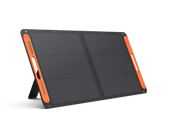
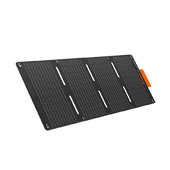
Jackery Solar Panels follow the same basic principle. They capture sunlight and turn it into usable electricity through photovoltaic cells. The difference is that they are designed to work as part of a portable power system rather than a fixed, built-in motorhome installation.
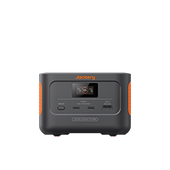
Instead of wiring them permanently into a traditional leisure battery system, you can connect them to a compatible Jackery Portable Power Station to collect and store energy more simply (as a Jackery Solar Generator).

Types of Solar Panels for Motorhomes
When choosing solar panels for a motorhome, it helps to look at them in two ways. The first is by usage, meaning how the panels are installed and used in daily travel. The second is by cell technology, which affects efficiency, price, flexibility, and overall performance. Both matter, because the best choice is not always the most powerful one on paper.
By Usage: Portable vs Permanent Solar Panels
Portable Solar Panels
Portable solar panels are not fixed to the motorhome roof. You set them up outside when needed and pack them away when you leave. This makes them attractive for travellers who want flexibility, especially if they often park in partial shade. For example, your motorhome might be parked under a tree to stay cool, while the panel can be placed a few metres away in direct sunlight.
Portable panels are also popular with people who do not want to drill into the roof or make permanent modifications. They are easier to start with, especially for beginners or occasional travellers. In many cases, they pair well with a portable power solution such as a Jackery Solar Generator.
Permanent Solar Panels
Permanent solar panels are mounted directly onto the motorhome roof and stay there full-time. Once installed, they start collecting solar energy whenever there is sunlight, with no daily setup required. This is a practical choice for frequent travellers, long-term motorhome users, and people who want a more integrated off-grid system.
Roof-mounted panels can continuously top up your leisure battery during daylight hours, which makes them convenient for everyday use. They also save interior storage space because the panels stay outside on the roof.
By Cell Technology: Main Solar Panel Types
Monocrystalline Solar Panels
Monocrystalline solar panels are usually considered the premium option for motorhomes. They are made from a single crystal structure, which helps them convert sunlight into electricity more efficiently than most other common panel types. This higher efficiency is especially useful on a motorhome, where roof space is limited and every panel needs to work hard.
They tend to perform better in low-light conditions than older or less efficient technologies, which can be useful for travel across different parts of Europe where sunshine levels vary by season and region. Monocrystalline panels also tend to have a sleek black appearance, which many motorhome owners prefer.
Jackery Solar Panels are a good example of monocrystalline solar panels. They are designed to offer strong conversion efficiency (25%) in a portable format, which makes them suitable for motorhome travel, especially for people who want dependable solar charging without installing a fully fixed rooftop system.
Polycrystalline Solar Panels
Polycrystalline solar panels are made from multiple silicon crystal fragments rather than a single crystal. They are generally more affordable than monocrystalline panels, which can make them appealing for budget-conscious buyers.
However, they are usually less efficient, meaning they need more surface area to produce the same amount of power. On a house roof that may not be a major issue, but on a motorhome, limited space can make lower efficiency more noticeable. They also tend to be slightly less effective in hot conditions or weaker sunlight compared with monocrystalline panels.
Thin-Film Solar Panels
Thin-film solar panels are made by placing very thin layers of photovoltaic material onto a surface. They are usually lighter and can be more flexible than crystalline silicon panels, which makes them interesting for curved roofs, lightweight setups, or situations where panel weight matters.
Their biggest advantage is flexibility.
Some thin-film panels can bend slightly, and their lighter build can make installation easier in certain cases. They may also perform reasonably well in partial shading or high temperatures, depending on the product design. Still, thin-film panels usually have lower efficiency than monocrystalline panels.
|
Type |
Category |
Main Feature |
Advantages |
Drawbacks |
Best For |
|
Portable solar panels |
Usage |
Movable and not fixed to the roof |
Flexible positioning, easy to store, no roof drilling, useful for shaded pitches |
Need manual setup, take up storage space, less convenient for daily moves |
Occasional travellers, beginners, flexible off-grid use |
|
Permanent solar panels |
Usage |
Fixed to the motorhome roof |
Always ready, charges automatically in daylight, no daily setup, saves storage space |
Less flexible in shade, installation is more complex, limited by roof size |
Frequent travellers, long trips, integrated solar setups |
|
Monocrystalline solar panels |
Cell technology |
High-efficiency single-crystal silicon |
Best efficiency, good for limited roof space, sleek design, strong overall performance |
Usually more expensive |
Motorhomes with limited roof space, higher-performance setups |
|
Polycrystalline solar panels |
Cell technology |
Multi-crystal silicon structure |
Lower upfront cost, reliable for basic solar charging |
Lower efficiency, needs more space, less common in compact premium setups |
Budget-conscious users with enough mounting space |
|
Thin-film solar panels |
Cell technology |
Lightweight, sometimes flexible design |
Light weight, can suit curved surfaces, flexible installation options |
Lower efficiency, needs more surface area, not ideal when space is tight |
Lightweight or unusual roof designs, niche motorhome setups |
For most motorhome owners, monocrystalline solar panels are often the most practical option because they make the most of limited space. If you want flexibility and do not want to install a fixed system, portable monocrystalline panels can be an especially useful combination.
What Size Solar Panel Do I Need for a Motorhome in Europe?
The right solar panel size for a motorhome depends on how much electricity you use each day, how large your battery is, and where and when you travel in Europe. A couple touring in summer and mainly charging phones, lights, and a fridge will need far less solar power than someone working remotely from a large motorhome with a coffee machine, router, and multiple devices running every day.
In simple terms, solar panel size is measured in watts (W). The higher the wattage, the more electricity a panel can produce in good sunlight. But rated wattage is only part of the picture. Real output changes with weather, season, shading, temperature, and how many useful sunlight hours you get.
For motorhomes in Europe, common solar panel sizes often include:
50W to 80W: small top-up systems for light use.
100W to 120W: popular for basic off-grid needs.
150W to 200W: a practical range for regular travel and moderate power use.
300W and above: better for larger energy demand, longer off-grid stays, or bigger vehicles.
A solar panel’s output means how much electricity it can generate over time. For example, a 100W solar panel does not produce 100 watts all day long. That figure is its maximum rated output under ideal test conditions. In real travel conditions, daily energy production is usually measured in watt-hours (Wh).
A simple estimate is:
Panel Wattage × Peak Sun Hours = Daily Output
So if you have a 100W panel and get around 4 good sun hours in a day, you may produce roughly:
100W × 4h = 400Wh per day
In practice, actual output is often a bit lower because of conversion losses, weather, panel angle, and temperature.

Solar Panel Size for a 110Ah Battery
A 110Ah battery is a common choice in a small motorhome, caravan, or campervan. In a 12V system, a 110Ah battery stores roughly:
110Ah × 12V = 1320Wh
In real use, not all of that is usually available, especially with older battery types. Still, for planning purposes, it is a useful starting point.
For this size of setup, many travellers choose 100W to 200W of solar, depending on how often they drive, whether they use campsites, and how much power they need each day.
Recommended Solar Panel Wattage for a 110Ah Battery
|
Solar Panel Wattage |
Typical Daily Output in Europe |
Charging Suitability for 110Ah Battery |
Best For |
|
50W |
150–250Wh/day |
Light top-up only |
Very light use, occasional weekends |
|
100W |
300–500Wh/day |
Basic charging support |
Lights, phone charging, water pump, small devices |
|
150W |
450–750Wh/day |
Better balance for off-grid use |
Small campervan or caravan with moderate daily use |
|
200W |
600–1000Wh/day |
Stronger recharge potential |
More regular off-grid travel, fridge plus daily essentials |
For a small motorhome, caravan, or campervan with a 110Ah battery, 100W to 150W is often enough for lighter use, while 200W gives more breathing room if you want better self-sufficiency.
Solar Panel Size for a 120Ah Battery
A 120Ah battery is often found in a larger motorhome or in setups with slightly higher daily power demand. In a 12V system, that gives roughly:
120Ah × 12V = 1440Wh
That extra capacity helps, but a bigger battery also needs enough solar input to recharge properly. For larger motorhomes, 150W to 300W is a more common range, especially if you use a compressor fridge, laptop, TV, or other appliances more often.
Recommended Solar Panel Wattage for a 120Ah Battery
|
Solar Panel Wattage |
Typical Daily Output in Europe |
Charging Suitability for 120Ah Battery |
Best For |
|
100W |
300–500Wh/day |
Basic support, slower recharge |
Low-demand larger motorhome setups |
|
150W |
450–750Wh/day |
Suitable for moderate use |
Everyday essentials with some off-grid time |
|
200W |
600–1000Wh/day |
Good all-round option |
Large motorhome use with fridge, charging, lighting |
|
300W |
900–1500Wh/day |
Strong recharge performance |
Longer off-grid stays, higher daily consumption |
For a larger motorhome with a 120Ah battery, 150W to 200W is often a sensible starting point, while 300W suits travellers who spend longer away from hook-ups or use more equipment each day.
If you do not want to build a full fixed solar system from scratch, a Jackery Solar Generator can be a simpler alternative or a useful backup for motorhome travel. Paired with Jackery Solar Panels, it lets you collect solar energy during the day and store it for later use in a portable power station.
How Many Solar Panels Do I Need for My Motorhome in Europe?
The number of solar panels your motorhome needs depends on four things working together: how much electricity you use each day, how much usable battery capacity you have, how much solar energy you can realistically collect where you travel, and how much system loss you should allow for. In Europe, location matters a lot.

Step 1: Work Out Your Daily Power Consumption
Start by listing the devices you actually use in a normal day in the motorhome. For each one, note its power in watts and how long you use it. Then convert that into watt-hours:
Daily energy (Wh) = Appliance watts × Hours used per day
For example:
- LED lights: 20W × 4h = 80Wh
- 12V fridge: 45W average × 10h compressor runtime = 450Wh
- Laptop: 60W × 2h = 120Wh
- Phone charging: 15W × 2h = 30Wh
- Water pump: 60W × 0.25h = 15Wh
- Total daily use = 695Wh/day
That total is the number you should size your solar around, not just the battery label. If you regularly use more appliances in colder weather, while working remotely, or while wild camping for several days, base your calculation on that heavier day rather than on your lightest one.
Step 2: Check Running Watts and Starting Watts
When sizing solar, people often focus only on daily energy use, but some appliances also need a short burst of extra power when they start. Running watts are the steady power an appliance needs while operating. Starting watts, also called surge or peak watts, are the brief higher demand at start-up, especially for appliances with motors or compressors.
Step 3: Convert Battery Size into Usable Energy
Motorhome batteries are often listed in amp-hours, such as 100Ah, 110Ah, or 120Ah. To estimate stored energy:
Battery energy (Wh) = Battery volts × Battery amp-hours
So a 12V 110Ah battery is:
12V × 110Ah = 1320Wh
A 12V 120Ah battery is:
12V × 120Ah = 1440Wh
In real life, not all of that is usually usable. Lithium systems often allow a much deeper discharge than many lead-acid setups, so your usable energy can be very different even if the Ah number looks similar. That is why panel sizing should be based on daily consumption and recharge needs, not only on battery size.
Step 4: Estimate Peak Sun Hours for Where You Travel
A solar panel’s rated wattage is measured under standard test conditions, not under normal touring conditions. To estimate real daily production, use peak sun hours. A peak sun hour is roughly the equivalent of one hour of solar irradiance at 1,000 W/m².
The basic formula is:
Solar energy per day (Wh) = Panel wattage × Peak sun hours × System efficiency factor
For a simple planning calculation, many motorhome users use a system efficiency factor of 0.7 to 0.85 to allow for temperature, cable losses, controller losses, angle, dirt, and imperfect conditions. A cautious middle-ground estimate is 0.75 to 0.8.
Here are some useful Europe examples for planning. These figures are not “one country, one fixed number”; they are representative values taken from solar resource tools and examples.
|
Country / Example |
Solar Resource Example |
Rough Planning Meaning |
|
UK, southern England |
Global Solar Atlas examples around 1023–1051 kWh/kWp/year |
About 2.8–2.9 peak sun hours/day on average |
|
Netherlands |
Example around 1031–1052 kWh/kWp/year |
About 2.8–2.9 peak sun hours/day |
|
Germany, south |
Examples around 1178–1185 kWh/kWp/year |
About 3.2 peak sun hours/day |
|
France |
Country range shown as 2.90–4.38 kWh/kWp/day |
Often around 3 to 4+ peak sun hours/day, depending on region |
|
Italy |
Country range shown as 2.67–4.54 kWh/kWp/day |
Often around 2.7 to 4.5 peak sun hours/day |
|
Spain |
Example sites around 1463–1647 kWh/kWp/year |
Roughly 4.0–4.5+ peak sun hours/day |
|
Greece |
Example sites around 1506–1599 kWh/kWp/year |
Roughly 4.1–4.4 peak sun hours/day |
(Source: Global Solar Atlas)
Step 5: Calculate the Solar Wattage You Need
Now use the daily energy number from Step 1.
Required solar wattage (W) = Daily energy use (Wh) ÷ Peak sun hours ÷ System efficiency
Example: Small campervan in Germany
Let’s say your daily use is 700Wh/day and you mainly tour in southern Germany, where a practical planning value is about 3.2 peak sun hours/day.
Using a system efficiency factor of 0.8:
Required solar = 700 ÷ 3.2 ÷ 0.8 = 273W
So in practice, you would usually round up to about 300W of solar.
Step 6: Decide How Much Safety Margin You Want
Motorhome solar is rarely sized for perfect weather only. A practical setup usually includes some spare capacity so you are not constantly watching the battery percentage. A good rule is to add around 20% to 30% headroom if you want more comfort, better cloudy-day recovery, or more freedom to stay off-grid longer.
So if your calculation says 200W, moving up to 240W or 300W often makes more sense than choosing the absolute minimum.

Can You Run a Motorhome on Solar Panels Alone?
Yes, a motorhome can run partly or even mostly on solar power, but not on solar panels alone. Solar panels generate electricity when there is enough sunlight. They do not store energy, and they cannot provide a stable supply at night, in bad weather, or whenever your power use is higher than the solar input at that moment. That is why a battery is such an important part of any motorhome solar setup.
Battery storage gives your motorhome a way to keep solar energy for later use. Without a battery, any solar power you generate would need to be used immediately, which is not how most people live on the road.
Several things decide how far solar can take you:
Your Daily Electricity Use: A couple charging phones and running lights will need far less energy than a family with laptops, a compressor fridge, and kitchen appliances.
Your Battery Capacity: A larger usable battery gives you more stored power for evenings, poor weather, and days when solar generation is lower.
Your Solar Array Size: More panel wattage means more charging potential, especially in good sunlight.
Where You Travel in Europe: Sun conditions vary a lot. Southern Europe in summer is much easier for solar-dependent travel than northern Europe in winter.
A Jackery Solar Generator offers a different way to use solar power in a motorhome. Instead of building a fully fixed onboard system, it combines portable solar panels with a portable power station that stores energy and provides output through built-in ports and AC sockets.
Jackery Solar Generators for Campervans, Caravans & Motorhomes
A Jackery Solar Generator can make a lot of sense for motorhome travel because it combines two things motorhome users usually need at the same time: portable solar charging and battery storage. Instead of building a fully fixed solar system from scratch, you get a setup that can collect solar energy during the day and store it for later use in one more flexible package.
A traditional motorhome solar setup often needs separate panels, charge control, battery storage, inverter planning, and permanent installation. A Jackery system keeps the idea simpler: the solar panels collect energy, the power station stores it, and the built-in outputs let you run or charge everyday devices from one unit.
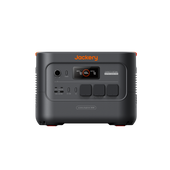
Jackery Solar Generator 2000 v2
The Jackery Solar Generator 2000 v2 is the more compact choice and will suit many motorhome users who want substantial power without moving up to a larger 3kWh system. It has a 2042Wh capacity, 2200W output, a LiFePO4 battery, 4000 life cycles, and app control. It also is the lightest and smallest 2kWh LiFePO4 power station in its class.

For many motorhome trips, 2042Wh is a practical middle ground. It is large enough for regular daily essentials and many common appliances, but still easier to manage than a larger high-capacity unit. That makes it appealing for couples, weekend travellers, and motorhome users who want meaningful off-grid support without choosing the biggest model available.
The Jackery Explorer 2000 v2 delivers reliable power for your motorhome trips, allowing you to seamlessly operate essential appliances like portable refrigerators, microwaves, and coffee makers. Say goodbye to frequent recharging and power limitations, ensuring a more comfortable and hassle-free adventure.
Due to the CTB structure, space efficiency is nearly doubled to 59%. Measuring just 335*264*292 mm—about the size of a medium desktop printer.
With Emergency Super Charge Mode, easily activated via the Smart App, the power station charges from 0% to 80% in just 52 minutes—perfect for when you need power in a hurry. Even in regular AC charging mode, a full charge takes only 103 minutes.
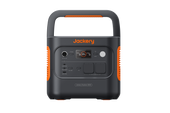
Jackery Solar Generator 3000 v2
The Jackery Solar Generator 3000 v2 is the larger option of the two and is better suited to motorhome users with higher daily electricity needs. It has a 3072Wh capacity and 3600W output, which is a power solution for RV and caravan camping. That makes it more appropriate for travellers who want stronger off-grid support for multiple devices and more demanding appliances.

A 3072Wh capacity gives you much more stored energy to work with than smaller power stations, which is useful if you stay parked for longer periods or want more margin between charges. In a motorhome, that extra capacity can make a real difference when you are running a fridge, charging work devices, and covering your normal evening power use from one stored energy source.
The 3000 v2 is rated at 3600W output, and Jackery’s product page highlights RV-style use cases such as powering a mini-fridge, portable heater, smartphones, and laptops. For motorhome users, that means it is not only about charging small electronics.
Built with advanced CTB⁸ (Cell-to-Body) tech—also used in EVs—for a stronger, more compact design. With inverter and PV combined, and battery cells built into the base, it boosts space efficiency by 14% (vs. Explorer 3000 Pro) and enhances durability for safer travel.
Features a 12-Layer BMS battery management system, constant voltage pure sine wave output, and surge protection—delivering stable power while safeguarding your appliances in any environment.
How to Choose the Best Solar Panels for a Motorhome?
Choosing the best solar panels for a motorhome is not only about buying the highest wattage you can find. The better approach is to match the panels to the way you actually travel in Europe.
Match the Panels to Your Travel Style
Choose solar panels based on how you actually travel in Europe, not simply by picking the highest wattage. A small campervan for summer weekends needs a different setup from a large motorhome used for long off-grid trips. The best option should fit your power needs, roof space, and budget without making the system too complicated.
Start with Daily Power Use
Your panel choice should begin with how much electricity you normally use each day. If you mainly power lights, phone charging, and a water pump, a smaller setup may be enough. If you also use a fridge, laptops, a router, or other appliances, you will need more solar capacity.
Consider Where You Travel
Solar output varies across Europe. Southern countries such as Spain, Italy, Greece, and Portugal usually offer stronger solar conditions than the UK, the Netherlands, Belgium, or northern Germany. If you travel mostly in northern Europe or outside peak summer, it often makes sense to choose a slightly stronger setup.
Check Panel Type and Efficiency
Monocrystalline panels are often the most practical choice for motorhomes because they provide better efficiency in a smaller space. This matters when roof area is limited. Higher efficiency also means more usable power from the same surface area, which is especially useful for compact motorhome setups.
Do Not Ignore Size, Weight, and Durability
A panel should not only perform well but also be practical to carry, store, or mount. Larger panels may give more output, but they can also be harder to handle, especially in smaller campervans. Durability matters too, because motorhome travel exposes panels to rain, dust, temperature changes, and repeated use outdoors.

How to Maximize the Efficiency of Solar Panels for a Motorhome?
Getting the best performance from motorhome solar panels is not only about buying the right panel. It also depends on how you use, position, maintain, and plan the whole setup. Even a high-quality panel can underperform if it is shaded, dirty, poorly angled, or paired with the wrong energy habits.
Park for Better Sunlight
Choose a parking spot with the clearest possible sun exposure. Trees, buildings, and even parts of the motorhome can cast shade and reduce solar output. Portable panels are more flexible because they can be moved into direct sun.
Reduce Shading
Even small areas of shade can lower panel performance more than expected. Check for roof boxes, vents, aerials, branches, or nearby objects that may block sunlight as the sun moves through the day.
Keep the Panels Clean
Dust, dirt, leaves, bird droppings, and salt can all reduce output. Regular cleaning with water and a soft cloth helps keep the panels working efficiently, especially on long or coastal trips.
Improve the Angle if You Can
Solar panels usually perform better when they face the sun more directly. Portable panels are useful because they can be tilted and repositioned, which can improve output in different seasons and locations.
Choose Efficient Panels
Higher-efficiency panels help you get more power from limited space. For many motorhome owners, monocrystalline panels are the most practical option because they make better use of available sunlight.
FAQs
The following are frequently asked questions about the solar panels for motorhomes in Europe.
1. How much does it cost for solar panels for motorhomes in Europe?
For the panels alone, a rough guide is around €200 for a portable 100W panel and €350 to €400 for a portable 200W panel, while some UK 100W motorhome-oriented rigid panels start from around £131. A full motorhome solar setup costs more once you add a charge controller, battery storage, inverter, mounts, and installation.
2. Is a 200W solar panel enough for a motorhome?
Often yes, for light to moderate daily use. A 200W panel is usually enough for essentials such as lights, phones, charging small devices, a water pump, and in many cases a 12V fridge, especially in sunnier parts of Europe. It is less likely to be enough if you rely heavily on laptops, coffee machines, TVs, or spend long periods off-grid in weaker sun.
3. Will a 200W solar panel run a 12V fridge?
In many cases, yes, but it depends on the fridge and the weather. Many 12V camping or motorhome fridges use roughly 240 to 600Wh per day, with typical running power around 30 to 50W and about 2 to 4 amps while cooling.
A 200W panel can often cover that in decent conditions, but usually only when paired with battery storage, because the fridge needs power day and night while solar output changes through the day.
4. How long do motorhome solar panels last?
Most good-quality solar panels are generally expected to last around 25 years or more, and 20- to 30-year performance warranties are common. In practice, portable motorhome panels may see more handling wear than fixed rooftop home panels, so real lifespan also depends on build quality, storage, and maintenance.
Final Thoughts
Solar panels are worth it for motorhomes because they make travel around Europe easier, more flexible, and less dependent on campsite hook-ups. They can help cover the everyday power needs that matter most on the road, from lights and phones to fridges, laptops, and other small essentials.
The key is to choose a setup that fits the way you actually travel. A smaller system may be enough for basic weekend use, while a larger setup makes more sense for frequent travel, bigger vehicles, or higher daily power use. For travellers who want a simpler and more flexible option, a Jackery Solar Generator can also be a practical way to bring solar power into motorhome life without building a fully fixed system from scratch.


