
























A household paying €140 per month before July could see its electricity costs rise by roughly €11 per month, although the exact change depends on consumption, tariff, discount and meter type. Electric Ireland increased residential electricity prices by 8% from 1 July 2026.
For a household on the average standard tariff, the supplier estimated an additional €2.66 per week, or €11.52 per month—approximately €138 over a year.
A separate change is due from 1 October 2026. The Commission for Regulation of Utilities approved higher network charges that could add about €41.25 annually for a typical domestic customer, although a lower PSO levy will offset part of that increase.
Customers should therefore check their July rates, contract expiry date and annual kWh use before comparing total first-year costs across suppliers. Moving flexible consumption to cheaper tariff periods may also help. This guide focuses on the Ireland electricity price increase; the separate 7.7% residential gas increase is mentioned only where it affects dual-fuel households.
|
Key Takeaways: |
|
Electric Ireland Price Increase 2026: What Changed?
Electric Ireland announced its 2026 price change on 28 May, confirming that new residential electricity and gas prices would apply from 1 July. The Electric Ireland price increase raised the average residential electricity bill by 8%, equivalent to €2.66 per week, €11.52 per month or €138.26 per year.
The change affects residential electricity customers across standard, NightSaver and smart-meter plans, although the euro impact varies with consumption and each plan’s discount. Electric Ireland increased electricity unit rates by 9.5% but left standing charges unchanged. The PSO levy initially remained at €1.46 per month, while VAT was calculated at the reduced 9% rate.
|
Change |
Effective date |
Average estimated impact |
|
Electric Ireland residential electricity |
1 July 2026 |
+8%, approximately €138 per year |
|
Electric Ireland residential gas |
1 July 2026 |
+7.7%, approximately €117 per year |
|
Regulated electricity network charges |
1 October 2026 |
Approximately €41.25 per year before the PSO adjustment |
Dual-fuel households also face a 7.7% increase in their average residential gas bill, equal to about €116.78 annually. However, electricity remains the focus here.
Explaining the decision, Executive Director Pat Fenlon said Electric Ireland could not delay the increase because of “sustained upward price pressure on our wholesale energy costs”. He also described it as the supplier’s first price increase since October 2022. Separately, regulated network charges change from October. That adjustment is not a second Electric Ireland price rise, and the lower 2026/27 PSO levy will offset part of its effect.

What Are Electric Ireland’s New Electricity Rates?
Electric Ireland raised residential electricity unit rates by 9.5% on 1 July 2026, producing an 8% increase in the overall Estimated Annual Bill. Standing charges and the PSO levy did not change in July. The table uses VAT-inclusive rates; pre-July figures are derived from the confirmed 9.5% unit-rate increase and rounded.
|
Charge |
Before July |
From 1 July 2026 |
Example Effective Rate after Discount |
|
Standard 24-hour unit |
34.74c/kWh |
38.04c/kWh |
32.72c with 14% discount |
|
NightSaver day |
37.10c/kWh |
40.62c/kWh |
34.94c with 14% discount |
|
NightSaver night |
18.29c/kWh |
20.03c/kWh |
17.23c with 14% discount |
|
Smart SST day |
37.02c/kWh |
40.54c/kWh |
32.43c with 20% discount |
|
Smart SST night |
19.45c/kWh |
21.30c/kWh |
17.04c with 20% discount |
|
Smart SST peak |
39.50c/kWh |
43.25c/kWh |
34.60c with 20% discount |
|
Urban standing charge |
€250.77/year |
€250.77/year |
No unit-rate discount |
|
Rural standing charge |
€314.98/year |
€314.98/year |
No unit-rate discount |
|
PSO levy |
€1.59/month |
€1.59/month |
No discount |
|
VAT |
9% |
9% |
Already included above |
(Data Source: Electric Ireland price schedule)
Rates and offers vary by plan. The 14% and 20% columns are examples rather than discounts available to every customer. Electric Ireland displays the standard unit price on the bill and shows the saving separately, so the effective unit rate is the amount remaining after the applicable discount.
Two customers can consequently pay different prices despite using the same supplier. Their results may reflect an existing-customer discount, a fixed-term offer, meter configuration or urban versus rural standing charge. Some discounted plans also require direct debit and online billing. If those conditions are no longer met—or an introductory contract expires—the discount or welcome credit may disappear. Compare the total annual cost, including fixed charges, instead of selecting a plan from its headline percentage alone.

How Much More Will the Electric Ireland Increase Cost You?
The extra amount depends primarily on the number of kilowatt-hours used. For the standard 24-hour tariff, the VAT-inclusive unit rate rose from approximately 34.74c to 38.04c per kWh—a difference of about 3.30c. Electric Ireland did not increase its standing charges in July.
Additional annual cost = annualel ectricity use x increase in unit cost + increase in fixed charges
Using the standard rate, a household consuming 4,200 kWh would calculate:
4,200 x €0.033 + €0 = €138.60
This closely matches Electric Ireland’s published average annual increase of €138.26; the small difference results from rounded unit rates.
|
Household profile |
Annual use |
Annual increase |
Monthly increase |
Two-month bill increase |
Increase after 14% discount* |
|
One-person apartment |
2,000 kWh |
€66.00 |
€5.50 |
€11.00 |
€56.76 |
|
Two-person household |
3,000 kWh |
€99.00 |
€8.25 |
€16.50 |
€85.14 |
|
Average household |
4,200 kWh |
€138.60 |
€11.55 |
€23.10 |
€119.20 |
|
Large all-electric home |
6,000 kWh |
€198.00 |
€16.50 |
€33.00 |
€170.28 |
*Illustrative calculation assuming a 14% discount applies to both the old and new unit rates. Standing charges are not discounted.
The table highlights two different pressures. A low-use apartment pays a smaller unit-rate increase, yet the annual standing charge represents a larger proportion of its total bill. An all-electric home using space heating, water heating or EV charging faces greater exposure because every additional kWh is charged at the higher rate.
For context, an urban household using 4,200 kWh on the 14% discounted 24-hour rate would pay approximately €1,644 annually after July, including the €250.77 standing charge and €19.08 PSO levy. This example excludes future October adjustments and any welcome credit.
|
Use Your Own Bill* |
|
Find your annual consumption in kWh, tariff name, urban or rural standing charge, current discount and discount expiry date. If annual use is unavailable, add the kWh figures from recent bills covering 12 months. Then multiply consumption by your actual rate change rather than relying on the average-household figure. |
What Is the Average Electricity Bill in Ireland in 2026?
The average electricity bill in Ireland can refer to several different figures, so the underlying calculation matters. Electric Ireland’s Estimated Annual Bill (EAB) is a standardised comparison figure rather than a forecast for every customer. It uses the CRU assumption of 4,200 kWh of annual consumption and combines the unit rate, standing charge, PSO levy and VAT.
Using Electric Ireland’s July 2026 standard 24-hour rate for an urban customer gives the following estimate:
|
Bill component |
Annual calculation |
|
Electricity use |
4,200 kWh × 38.04c = €1,597.68 |
|
Urban standing charge |
€250.77 |
|
PSO levy |
€19.08 |
|
Estimated annual bill |
Approximately €1,868 |
|
Monthly equivalent |
Approximately €156 |
(Data Source: Electric Ireland EAB explanation)
These figures already include 9% VAT. A rural customer with the same consumption would pay about €1,932 annually because the rural standing charge is €314.98, compared with €250.77 for an urban account. That €64 difference matters most in a low-use home, where fixed charges represent a greater share of the bill.
An actual household bill reflects meter readings, consumption timing, tariff, discount and credits. A one-person apartment using 2,000 kWh could pay far less than the EAB, while a family home using 5,000–6,000 kWh would exceed it. Electrically heated properties may consume considerably more, especially when space heating, hot water and cooking all depend on electricity.
Winter bills are often higher because lighting and heating run for longer, while occupants may spend more time indoors. Equal-payment plans can smooth these seasonal differences without reducing the annual cost.

Could Bills Rise Again from October 2026?
A further bill change is expected from 1 October 2026, but it should not be confused with Electric Ireland’s July increase. The October adjustment comes from the Commission for Regulation of Utilities’ annual review of electricity network charges.
The CRU approved higher transmission and distribution charges for the period from 1 October 2026 to 30 September 2027. These charges fund the operation, maintenance and expansion of the networks managed by EirGrid and ESB Networks. For a typical domestic customer, the increase is estimated at approximately €41.25 over the year, or €3.44 per month.
Part of that impact will be offset by a lower Public Service Obligation levy. The domestic PSO charge falls by 66%, from €1.46 to €0.51 per month before any applicable VAT treatment. The levy supports eligible renewable electricity schemes.
|
Change |
Decision-maker |
Timing |
|
8% average electricity bill increase |
Electric Ireland |
1 July 2026 |
|
Higher network charges and lower PSO levy |
CRU |
1 October 2026 |
|
Any later retail price change |
Individual supplier |
Only if announced |
(Data Source: CRU)
Network costs do not always appear as a separate, easily identifiable line on household bills. Suppliers pay regulated network charges and recover them through their tariff structures, while the PSO levy is normally listed separately. The final October effect will therefore depend on how the revised costs are incorporated into each plan.
No additional Electric Ireland retail increase should be treated as confirmed unless the supplier announces one. Wholesale-market movements may influence later electricity prices in Ireland, but they do not establish what Electric Ireland will charge.
Why Are Electricity Prices Increasing in Ireland?
Irish household electricity prices were reported at 40.42c per kWh in May 2026, almost 40% above the cited EU average of 28.96c. That comparison includes taxes and levies and helps explain why customers asking “Why is Electric Ireland so expensive?” often need to look beyond a single supplier’s margin.
Wholesale Energy Costs and Imported Fuels
Ireland generates increasing amounts of renewable electricity, but gas-fired power stations remain important when wind and solar output cannot meet demand. Most natural gas and other fossil fuels are imported, leaving the market exposed to international supply disruptions, geopolitical conflict and currency movements.
Electric Ireland linked its July increase to sustained wholesale cost pressure and volatility associated with conflict in the Middle East. Wholesale prices do not pass directly into retail tariffs each day, however. Suppliers purchase energy in advance to reduce short-term volatility, a process known as hedging. This can delay both increases and reductions.
Network Investment and Security of Supply
Around 30% of a household’s overall energy cost relates to electricity networks, according to the CRU. Charges support EirGrid and ESB Networks in maintaining existing infrastructure, connecting homes and renewable projects, and expanding capacity for electric vehicles, heat pumps and new developments.
A grid receiving more weather-dependent renewable generation also requires forecasting, balancing services, backup capacity and stronger transmission links. These measures support reliability but create costs that ultimately form part of customer tariffs.
Charges Added to the Energy Rate
A bill contains more than electricity consumption. Customers also pay an urban or rural standing charge, the PSO levy and VAT. The standing charge applies even when very little electricity is used, while rural customers generally pay more because the network serves a more dispersed area. From October 2026, network charges rise while the PSO levy falls.
Your Tariff Can Amplify the Increase
An unusually high bill is not proof that the supplier’s base price is the only cause. Consumption may have risen due to electric heating, immersion use or EV charging. A fixed-term discount may also have expired, or a smart-tariff customer may be using too much power during the peak period.
Customers should compare annual kWh use with the same period last year, confirm the tariff and discount on the bill, and check whether consumption can be shifted to a cheaper time band. These checks separate price inflation from changes within the household.

Is Electric Ireland More Expensive Than Other Irish Suppliers?
Electric Ireland may be cheaper for one household and more expensive for another. A supplier comparison depends on consumption, meter type, payment method and the timing of electricity use—not simply the advertised discount. Market offers also change frequently, so naming one permanent winner would quickly become misleading.
|
Comparison Factor |
Why It Matters |
|
First-year cost |
Combines unit rates, standing charges and sign-up incentives |
|
Unit rate |
Has a greater effect on households with high annual consumption |
|
Standing charge |
Represents a larger share of costs in low-use homes |
|
Welcome credit |
Reduces year-one cost but may not continue |
|
Discount duration |
A strong introductory discount may expire after 12 months |
|
Smart tariff periods |
Savings depend on when electricity is consumed |
|
Exit fee |
Can reduce the value of switching during a contract |
|
Urban or rural charge |
Rural standing charges are generally higher |
|
Microgeneration export rate |
Affects the value received by households exporting solar electricity |
First-year cost is usually the most useful starting point because it converts several charges into one annual figure. Even then, the calculation should use the reader’s own annual kWh rather than a generic household estimate. A family consuming 6,000 kWh may benefit more from a lower unit rate, whereas a one-person apartment should pay closer attention to standing charges.
Smart tariffs require an additional check. A low overnight rate may appear attractive, but the plan can cost more if much of the household’s electricity is used during the evening peak. Solar owners should compare both import costs and microgeneration export payments rather than assessing either rate alone.
Electric Ireland’s welcome credit or unit-rate discount should also be separated from the underlying tariff. When a credit has been used or a fixed-term offer ends, the second-year cost may be higher even if consumption stays unchanged.
For a current comparison, enter your annual consumption, meter type, urban or rural classification and usage pattern into a CRU-accredited comparison service. Review the full annual cost, contract length and conditions before switching, as the cheapest result can change whenever suppliers update their offers.

Who Is the Cheapest Electricity Supplier in Ireland Right Now?
There is no single cheapest electricity supplier for every Irish household. The result depends on annual consumption, meter type, urban or rural classification, usage times, unit-rate discounts, welcome credits and standing charges. A plan leading the rankings for a 4,200 kWh urban household may not be cheapest for a low-use apartment, an EV owner or a rural home with solar panels.
To compare current offers correctly:
1. Find your annual electricity consumption in kWh on a recent bill or add 12 months of meter readings.
2. Confirm whether ESB Networks classifies the property as urban or rural.
3. Record your tariff, discount percentage and contract end date.
4. Compare total first-year cost rather than the unit rate alone.
5. For smart plans, review day, night, peak, EV and free-weekend periods.
6. Subtract welcome credits, but add any early exit fee.
7. Calculate the likely cost after the introductory offer ends.
Current comparison websites may advertise savings of several hundred euros, but those figures depend on their consumption assumptions and available promotions. Rankings change whenever a supplier revises its rates or launches an offer.
Should You Stay with Electric Ireland or Switch?
Staying with Electric Ireland may be reasonable when a competitive retention offer is available, the existing contract carries an exit fee, or the current tariff suits the household’s consumption pattern. Some customers may also prefer to retain familiar billing arrangements, equal payments or account-support services.
Switching deserves consideration when an introductory discount has expired and another supplier produces a lower total annual cost after all charges. An EV owner might benefit from a cheaper overnight charging period, while a solar household may prefer a plan combining manageable import costs with a stronger microgeneration export rate. Neither feature should be assessed on its own: a high export payment can be outweighed by expensive imported electricity.
|
Question |
If Yes |
If No |
|
Has your current discount expired? |
Compare new offers now |
Check the exit fee first |
|
Is another plan cheaper after fees and credits? |
Examine its tariff conditions |
Ask about a retention offer |
|
Can you shift substantial use to cheap hours? |
Consider a smart or EV tariff |
A flat tariff may be safer |
|
Do you export solar electricity? |
Compare import and export rates together |
Focus on import cost |
|
Does the saving exceed the exit fee? |
Switching may be worthwhile |
Wait until the contract ends |
An electricity switch usually completes within five to ten days, although some cases can take up to four weeks. The physical supply is not disconnected because ESB Networks continues delivering electricity; only the company billing for it changes.
Submit a final meter reading where requested to prevent an estimated closing bill. Electric Ireland will issue a final account, and any outstanding balance remains payable after the switch. If the account is in credit, confirm how and when the balance will be refunded.
A smart meter stays at the property, but tariff compatibility still needs checking. Some offers require half-hourly data, direct debit or online billing, and changing to a smart time-of-use configuration may affect which tariffs are available later.
Would a Smart Tariff Reduce Your Bill?
A smart tariff can reduce costs when a household can move enough electricity use into cheaper periods. It is not automatically better than a flat rate: savings depend on when appliances, heating and EV charging operate.
|
Tariff Category |
How Charging Works |
Best Suited to |
|
Standard 24-hour |
One unit rate at all times |
Homes with limited ability to change usage times |
|
Day/night |
Separate daytime and overnight rates |
Households running major loads at night |
|
Smart time-of-use |
Day, night and higher-priced peak periods |
Users who can avoid the evening peak |
|
EV-focused |
Very low rate during a short overnight window |
EV owners able to schedule charging |
|
Dynamic |
Price changes every 30 minutes |
Highly flexible users willing to monitor rates |
(Data Source: Electric Ireland dynamic tariffs)
A home occupied throughout the day may distribute electricity use across cooking, laundry, hot water and home-office equipment. A 24-hour tariff offers predictable costs, although a smart plan could work if the dishwasher, washing machine and immersion heater are scheduled outside expensive periods.
A commuter household often has a pronounced evening peak. Cooking, laundry and entertainment may coincide between 5pm and 7pm, when standard smart time-of-use plans usually apply their highest rate. Unless some demand can move to the night period, a headline night discount may not compensate for costly peak consumption.
An EV household has more flexibility because charging represents a large, schedulable load. Connecting the car in the evening but delaying charging until a low-cost overnight window can materially change the annual calculation. The same period may suit a dishwasher or battery charger, subject to manufacturer and fire-safety instructions.
Dynamic tariffs go further by tracking wholesale-market conditions throughout the day and assigning a new rate to each half-hour interval. Prices can become unusually low when supply is plentiful, but they may also rise sharply during tight market conditions. Electric Ireland provides the next day’s prices in advance and applies a price cap, yet monthly costs remain less predictable.
Eight Practical Ways to Reduce an Irish Electricity Bill
The most valuable step is not always using less electricity. A household may save by changing supplier, choosing a tariff suited to its routine or moving existing consumption into cheaper hours. Start with annual cost and high-power appliances before concentrating on small loads.

1. Recompare Suppliers When a Discount Expires
This suits any household reaching the end of a fixed-term offer. Compare total first-year cost, standing charges and credits using annual kWh consumption. Switching may be less attractive when an exit fee still applies. It changes the price paid rather than reducing energy use.
2. Move Flexible Loads Outside Peak Periods
Smart-tariff customers with evening demand can delay suitable appliances until the night or daytime rate applies. Cooking and essential heating may be difficult to move, limiting the saving. This action shifts consumption without reducing it.
3. Schedule Laundry, Dishwashing and EV Charging
Homes with a smart meter, EV or programmable appliances can use cheaper tariff windows. Follow appliance safety instructions and avoid running unsuitable equipment unattended. Energy use remains broadly the same, but its timing and cost change.
4. Control the Immersion Heater
Households using electricity for hot water should check timers, thermostats and how long the immersion runs. Heating a full cylinder for longer than needed wastes energy, although large families still require sufficient hot water. Better control reduces consumption rather than merely moving it.
5. Review Electric Heating Settings
This matters most in electrically heated homes and properties relying on portable space heaters. Lowering thermostats slightly, heating occupied rooms and correcting timer settings can cut demand. Comfort, health and damp prevention set sensible limits. The measure reduces electricity use.
6. Identify Persistent Standby Loads
Homes with numerous televisions, consoles, computers or older appliances can use an energy monitor or suitable smart plug to find continuous loads. Modern devices may consume very little in standby, so savings vary. Switching unnecessary equipment off lowers consumption.
7. Improve Draught-Proofing
Apartments and houses using electric heating benefit when gaps around doors, windows and loft hatches are sealed. Costs and results depend on the building, and ventilation openings must not be blocked. Draught-proofing reduces the energy required to maintain indoor temperature.
8. Track kWh Every Month
This suits every household, especially those whose bills vary sharply. Record monthly kWh and compare it with the same period in the previous year. Euro totals alone can hide the difference between higher rates and higher consumption. Monitoring does not directly save electricity, but it reveals where corrective action is needed.
The strongest combination is usually to secure a competitive tariff, control water and space heating, and then shift flexible high-power loads into cheaper periods.
Can Solar Power Reduce Exposure to Electricity Price Increases?
Solar power can reduce the amount of electricity purchased from a supplier, but panel capacity alone does not determine the saving. The key figure is how much generation the household uses instead of importing at the applicable tariff:
Avoided electricity cost = solar energy used directly × applicable import rate
Electricity generated while the washing machine, immersion heater or home-office equipment is running can supply those loads directly. A battery may store unused daytime generation for evening use, although charging, conversion and standby losses mean that not every generated kWh reaches an appliance.
Irish output also varies sharply by weather and season. Long summer days can produce a sizeable surplus, while winter generation is materially lower because daylight hours are shorter and the sun remains lower in the sky. Shading, roof orientation, panel angle and system losses create further variation. A 4 kWp array therefore does not deliver 4 kW continuously or guarantee a fixed annual saving.
A grid-connected rooftop installation supplies the home through its electrical system and may export surplus generation under Ireland’s microgeneration arrangements. Export payments create additional value, but the export rate may be lower than the retail price avoided through self-consumption.
Portable solar generators serve a different purpose. They store energy from compatible portable panels and supply appliances through their own outputs. They should not be connected directly to household wiring or used to energise a socket circuit. Any changeover or fixed backup arrangement requires suitable equipment and professional electrical assessment.
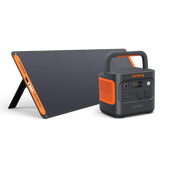
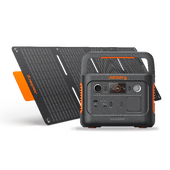
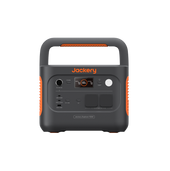
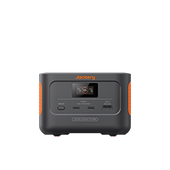
Using Jackery Solar Generators
Jackery Solar Generators are optional portable systems for camping, off-grid activities and selected backup loads. They are not universal replacements for the mains supply, nor do they automatically reduce the whole household electricity bill.

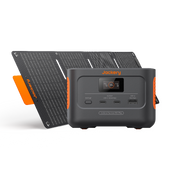
Jackery Solar Generator 2000 v2
The Jackery Solar Generator 2000 v2 combines a 2,042Wh battery with 2,200W continuous AC output and up to 400W solar input. Its size suits camping, mobile work, charging phones and laptops, or powering selected appliances within the output limit. During a short outage, it could support essential loads such as communications, lighting or refrigeration, subject to their start-up power and actual energy demand.
This model is the more portable option for a household that has completed a moderate essential-load audit and does not need 3 kWh of storage.
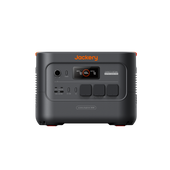
Jackery Solar Generator 3000 v2
The Solar Generator 3000 v2 provides 3,072Wh of capacity, 3,600W continuous output and up to 1,000W solar input. Its additional capacity and output headroom suit more demanding appliances, several simultaneous loads or longer emergency and off-grid use. Greater capability also means a larger unit to transport and store.
|
Consideration |
Solar Generator 2000 v2 |
Solar Generator 3000 v2 |
|
Best-use profile |
Moderate portable and backup demand |
Higher-load or longer-duration use |
|
Capacity |
2,042Wh |
3,072Wh |
|
Continuous output |
2,200W |
3,600W |
|
Maximum solar input |
400W |
1,000W |
|
Portability |
Easier to move |
Larger system |
|
Main decision factor |
Moderate essential-load audit |
Higher power and energy requirement |
Before purchase, confirm the current Irish product configuration, plug format, included panels and warranty terms. Appliance runtime will be lower than a simple capacity-divided-by-wattage calculation because of inverter losses, cycling loads and battery operating limits.
Most importantly, these are portable power systems—not automatically grid-connected rooftop installations. Savings depend on solar electricity actually captured and used. Charging from the grid at the same tariff merely moves electricity through the battery and introduces losses; charging during a cheaper tariff window may reduce cost, but it does not reduce consumption.
What Support Is Available If You Cannot Pay the Higher Bill?
If the higher charge is becoming unmanageable, contact Electric Ireland before missed payments accumulate. Early engagement gives the supplier more scope to arrange affordable repayments and reduces the risk of escalation.
Electric Ireland Payment and Hardship Support
Electric Ireland can discuss flexible payment plans, instalment arrangements and Pay As You Go options. Its Compassionate Assistance Fund provides account relief to eligible customers identified with partners including MABS and ALONE. Support is assessed individually rather than granted automatically.
Fuel Allowance and Additional Needs Payment
Fuel Allowance helps eligible households receiving qualifying social welfare payments or meeting the relevant age, residence and means-test conditions. Working Family Payment became a qualifying payment in 2026.
What was previously called an Exceptional Needs Payment is now generally provided through the Additional Needs Payment scheme. A person facing an essential expense, including an exceptional electricity or fuel cost, can apply through the Community Welfare Service. Eligibility depends on income, household circumstances and the specific need.
Free Independent Advice
The Money Advice and Budgeting Service (MABS) offers confidential, independent assistance with household debt and supplier negotiations. Its helpline is 0818 07 2000. The Society of Saint Vincent de Paul may also provide advice or direct help following an assessment of the household’s situation.
Vulnerable-Customer Protection
Tell Electric Ireland if anyone in the home depends on electrically powered medical equipment or is particularly vulnerable because of age, disability or health. Eligible customers can join the supplier’s vulnerable-customer register and receive additional protections. Registration does not cancel charges, so payment difficulties should still be discussed promptly.
Act Before Arrears Grow
Check that the bill uses an actual meter reading, prepare an affordable monthly budget and contact the supplier with recent account details. Under the Energy Engage Code, participating suppliers will not disconnect customers who continue engaging with them; disconnection is a last resort.
Electric Ireland Price Increase 2026: Household Action Checklist
Use this checklist before changing tariff, supplier or energy system:
l Confirm the exact name of your current Electric Ireland tariff.
- Check the unit rate applied from 1 July 2026.
- Find your annual electricity consumption in kWh.
- Record the urban or rural standing charge and current PSO levy.
- Check your discount, contract expiry date and possible exit fee.
- Calculate the new annual cost using your own consumption.
- Compare total first-year offers, including credits and fixed charges.
- Assess whether a smart, day/night or EV tariff matches your routine.
- Review how much electricity you use during peak periods.
- Identify appliances that could move to cheaper hours.
- Consider solar only after measuring daytime consumption and seasonal demand.
- Compare solar self-consumption value with any export payment.
- Check that large purchases offer reasonable savings for their cost.
- Contact Electric Ireland promptly if the new bill may be difficult to pay.
- Repeat the comparison when a discount expires or household electricity use changes materially.
FAQs
The following are the frequently asked questions about the Electric Ireland price increase in 2026:
1. Did Electric Ireland increase prices?
Yes. Electric Ireland increased average residential electricity bills by 8% from 1 July 2026. Its electricity unit rates rose by 9.5%, while standing charges remained unchanged. Residential gas bills also increased separately by 7.7%.
2. Why is Electric Ireland so expensive?
Electric Ireland’s prices reflect wholesale energy costs, supplier hedging, network charges, standing charges, the PSO levy and VAT. A high bill may also result from increased consumption, an expired discount or an unsuitable tariff. Compare the total annual cost rather than the unit rate alone.
3. Will Electric Ireland increase prices again in 2026?
No further Electric Ireland retail increase should be treated as confirmed unless the supplier announces one. Separate regulated network-charge changes take effect from 1 October 2026, partly offset by a 66% reduction in the domestic PSO levy.
4. Who is the cheapest electricity supplier in Ireland at the moment?
There is no single cheapest supplier for every household. The result depends on consumption, meter type, supply region, usage times, discounts, credits and standing charges. Use a CRU-accredited comparison website with your own annual kWh figure.
5. How much will the 8% increase add to my bill?
Electric Ireland estimates that the increase will add €2.66 per week, €11.52 per month or €138.26 per year for an average household on the standard tariff. High-use homes will generally pay more, while low-use households should see a smaller increase.
6. What is the average electricity bill in Ireland?
Using Electric Ireland’s standard urban 24-hour tariff and the CRU assumption of 4,200 kWh per year gives an Estimated Annual Bill of approximately €1,868, or €156 per month. Your actual cost depends on consumption, discount, meter and supply region.
7. Are rural Electric Ireland customers charged more?
Rural customers generally pay a higher standing charge. From July 2026, the VAT-inclusive annual standing charge is €314.98 for a rural account compared with €250.77 for an urban account. Unit rates may remain the same, depending on the plan.
8. Can I avoid an exit fee when switching?
Usually, you can avoid an exit fee by switching after the fixed contract term has ended. You may also cancel a new contract within the applicable cooling-off period. If switching early, compare the expected saving with the fee and ask whether it can be waived.
Final Thoughts
Electric Ireland’s July 2026 increase has already raised residential electricity unit rates, adding an estimated €138 per year to the average standard-tariff bill. The amount your household pays will depend on annual kWh consumption, meter type, urban or rural standing charges, tariff structure and any discount still applied to the account.
The regulated network-charge adjustment from 1 October is a separate change rather than another confirmed Electric Ireland retail increase, while the lower PSO levy will offset part of its effect.
Before winter demand rises, calculate your annual cost from actual consumption and compare complete supplier offers, including standing charges, credits and exit fees. Choosing a better-value plan or moving EV charging, laundry and water heating away from expensive periods may deliver more meaningful savings than concentrating only on low-wattage appliances.


